
Trolleys and carts are one of the major industrial transportation methods, and choosing their wheel materials between polyurethane and rubber isn’t just a cosmetic decision, because the right one runs cooler, quieter, and longer, often paying for itself in avoided downtime.
This guide will lead you through the thought process of comparing how each type of caster wheel is made, where it excels, and how to select confidently based on real operating conditions.
Basics for Different Caster Wheels
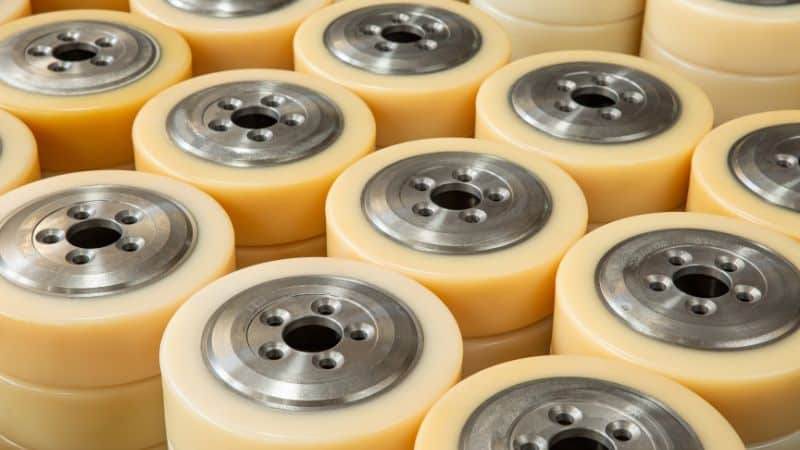
Polyurethane Wheels (PU casters)
Polyurethane wheels are typically produced by casting liquid prepolymer into molds around a metal or plastic hub, then curing to form a bonded tread. They can also be compression molded or injection molded in some applications, but cast-bonded urethane treads on steel or aluminum cores are standard for industrial casters and drive wheels.
A key advantage is tunability. Chemists can vary isocyanates, polyols, and curatives to dial in properties: hardness, rebound, cut resistance, and chemical tolerance. Industrial wheel treads commonly range from about Shore A 80 to Shore D 55, with the bulk of warehouse and platform cart wheels in the Shore A 85–95 band. Softer urethanes improve traction and ride; harder urethanes increase load capacity, reduce rolling resistance, and resist chunking and abrasion. The bond to the hub, often enhanced with primers, mechanical interlocks, or knurling, is critical to prevent tread separation under torque or heat buildup.
Rubber Caster Wheels
Rubber wheels are built from natural rubber (NR) or synthetic rubbers like SBR, EPDM, NBR (nitrile), or silicone, with fillers, oils, and curing systems (sulfur, peroxides) setting final properties. They may be solid rubber treads bonded to hubs, semi-pneumatic (airless) for shock absorption, or fully pneumatic tires on rims for vehicles and tuggers.
Natural rubber is highly elastic with excellent traction and fatigue resistance, making it comfortable and grippy on uneven surfaces. Synthetic rubbers expand the envelope: nitrile resists oils, EPDM handles weathering and many chemicals, and silicone tolerates higher temperatures. Hardness typically spans Shore A 50–80 for wheels. Softer compounds isolate vibration and protect cargo and floors, while harder rubbers improve wear and carrying capacity. Unlike polyurethane, rubber’s compound-specific behavior varies widely, and two rubber wheels can feel and perform very differently depending on formulation.
Key Material Properties

Load Capacity, Hardness, and Rolling Resistance
Polyurethane wheels have a higher modulus, meaning they deflect less under load. This limits rolling resistance and heat buildup, allowing them a better load-bearing capacity than a comparably sized rubber wheel. This combination of properties makes polyurethane a good choice for reach trucks, AGVs, and pallet handling in warehouses and smooth indoor floors, where its low rolling resistance reduces energy consumption on powered equipment.
Rubber wheels are softer and more elastic, deforming more under load. This trades load capacity for comfort, as it cushions impacts and distributes pressure, protecting delicate cargo on rough floors. However, this increased deformation can raise the required push/pull force.
Traction, Shock Absorption, and Noise
Rubber’s elasticity provides superior traction and a higher level of shock absorption on uneven surfaces like rough concrete, asphalt, or across expansion joints. This clear advantage in comfort and sound dampening makes rubber the unequivocal recommendation for rough concrete and outdoor terrain, where pneumatic or semi-pneumatic tires best isolate damaging shocks. While polyurethane has superior noise reduction to hard plastics, it generally absorbs less shock than rubber.
Floor Protection and Non-Marking Qualities
Polyurethane is widely regarded as non-marking. It protects sensitive floors like epoxy, polished concrete, and tile by resisting scuffs and avoiding the use of marking agents. This makes it the safe default for facilities where housekeeping is critical, such as in pharma, food, and finished goods, where its low-shedding, non-marking nature is essential.
Many rubber wheels contain carbon black, and the sustained wear and tear will damage their composition and leave gray or black trails on light-colored floors. While non-marking rubber compounds (using silica) are available, they often sacrifice some abrasion resistance. If a clean floor is a necessity, polyurethane typically wins.
Durability: Wear, Cutting, and Chunking Resistance
The dense microstructure of a well-formulated polyurethane tread gives it excellent resistance to abrasion, tearing, and chunking. Its higher tear strength holds up against harsh conditions like metal chips, embedded grit, and intermittent impacts, making it ideal for foundries, fabrication, and heavy-duty assembly.
Rubber wheels offer good general abrasion resistance, but sharp edges and continuous scraping tend to nick and tear rubber treads more readily. Pneumatic designs mitigate this with an air cushion, but they introduce maintenance and higher rolling resistance.
Chemical, Oil, and Temperature Resistance
Polyurethane provides a broad “good enough” resistance to oils, greases, and many solvents, maintaining integrity where standard natural rubber would swell or degrade.This generally makes it the top choice for wet, oily, or chemical environments like food & beverage plants, and it can be formulated for enhanced wet traction and cold resistance.
Rubber’s behavior is highly compound-specific. Nitrile resists oils, EPDM handles weathering but not petroleum, and silicone tolerates extreme heat but sacrifices tear strength. For mainstream industrial use, urethane’s wide window of resistance is a safe baseline. There are also niche applications that demand resistance to chemicals or extreme temperatures. For example, steam sterilization, ovens, aggressive chemicals like acid or alkaline solutions, etc. Such usages call for a purpose-built rubber compound like silicone or EPDM.
High-Speed Operation
A key performance trade-off emerges in high-speed applications. For high-speed or motorized equipment like tuggers, rubber tires (especially pneumatic) are often recommended. Their lower hysteresis (internal friction) allows them to run cooler under sustained speed, preventing the dangerous heat buildup that can occur with standard polyurethane.
This heat in polyurethane is due to its higher hysteresis, where energy is transformed into heat as the material continuously deforms and recovers. However, for moderate-speed AGVs/AMRs on smooth floors, specialized modern formulations like microcellular or thermally stable polyurethanes have mitigated this issue, allowing urethane to remain a common choice due to its superior torque capacity, non-marking nature, and wear resistance.
Choose Between Polyurethane or Rubber
To make the optimal choice, systematically evaluate your operating conditions against these key criteria. This guide consolidates the critical trade-offs into a checklist.

Load & Floor Surface
- For high loads on smooth, indoor floors (e.g., epoxy, polished concrete): Choose polyurethane for its superior load capacity, low rolling resistance, and floor protection.
- For rough or outdoor terrain (e.g., asphalt, cracked concrete): Choose rubber (preferably pneumatic or semi-pneumatic) for its unmatched shock absorption and traction.
Operational Speed & Noise
- For high-speed or continuous travel (e.g., motorized tuggers): Choose rubber to avoid the dangerous heat buildup that can occur with polyurethane.
- For slow to moderate speeds with noise sensitivity: Softer rubber or softer polyurethane are options, but test them on your actual floor.
Environmental & Chemical Exposure
- For oils, greases, and general chemical splash: If only an average level of protection is needed, polyurethane is adequate enough. However, NBR would be a better choice for enhanced resistance against these exposures.
- For extreme conditions (steam, strong caustics, high heat): Verify a specific rubber compound (e.g., EPDM, Nitrile) is required.
- For cleanrooms, labs, or sensitive floors: Polyurethane is the preferred non-marking, low-shedding option.
Total Cost of Ownership
Weigh the initial cost against long-term factors. Polyurethane often has a higher upfront cost but can lower total cost indoors due to longer tread life and reduced energy consumption. For mixed terrain, rubber’s ability to protect cargo and equipment from vibration may justify its potentially shorter service life.
Conclusion: Making the Right Choice
In the comparison of polyurethane vs rubber wheels, the choice is less about right and wrong and more about aligning material physics with the job. Polyurethane wheels dominate on smooth indoor floors where load capacity, efficiency, floor protection, and chemical resistance matter most. Rubber excels where traction, shock absorption, terrain variability, and higher travel speeds drive outcomes.
When in doubt, prototype on the actual surface and duty cycle. After all, wheels are small components that make an outsized difference in safety, ergonomics, and cost.
Frequently Asked Questions
My facility has a mix of smooth and rough floors. Which wheel material is better?
In a mixed-surface environment, a single wheel type often involves trade-offs. For the best compromise, consider a dual-wheel caster cart if possible, or prioritize the surface where the cart will spend the most time and highest loads. Alternatively, a softer, microcellular polyurethane might offer a middle ground, but you should conduct tests first to determine the better strategy.
How does wheel width affect the performance of polyurethane vs. rubber wheels?
Wheel width is a critical factor. A wider wheel of either material will have a larger contact patch, which distributes the load better, reduces floor pressure (PSI), and can improve stability. For polyurethane, a wider wheel can further enhance its innate load capacity. For rubber, a wider wheel can help mitigate its higher rolling resistance on smooth floors by reducing deformation. On rough terrain, a wider pneumatic rubber tire provides even better flotation and shock absorption.
Are there any maintenance considerations specific to polyurethane or rubber wheels?
Yes, there definitely are. Rubber wheels, especially pneumatic ones, require periodic checks for air pressure and are more susceptible to picking up and embedding debris like metal shavings or glass, which should be regularly picked out. Polyurethane wheels, while largely maintenance-free, should be inspected for “flat-spotting” if a loaded cart is stationary for very long periods, and their bond to the core should be checked for any signs of separation under heavy torque or impact loads.
Can I replace just the tread on a worn caster wheel?
This depends entirely on the wheel’s construction. Most standard industrial polyurethane and solid rubber wheels are manufactured as a single, bonded unit (tread and hub) and cannot be retreaded. When worn, the entire wheel is replaced. However, some heavy-duty or specialized systems use a replaceable tire mounted on a separate rim, similar to a car tire. This is less common for general material handling carts and more typical for specific industrial vehicles.