
In many worksites, loads hang in the air, not on a platform, making standard scales useless. That gap leads many teams to rely on a tool built for suspended loads: the crane scale.
This piece of weighing devices serves countless industries, including construction, manufacturing, shipping, mining, agriculture, and more. Therefore, whether you are a procuring specialist, an onsite overseer, or just someone who wants to learn more, it would be very helpful to read through our article on crane scales about their main types, key features, and common questions that affect daily lifting work.
Operations and Components of a Crane Scale

A crane scale measures the weight of the load while it hangs from a crane or hoist. It attaches between the crane hook and the load, and when the crane lifts the load, force pulls on the scale. The scale’s load cell senses this force and converts it into an electrical signal, which the system then turns into a weight value. A digital display shows the result in real time.
Most crane scales run on batteries and allow weight measurement while the load stays in the air, reducing the need to place heavy items on floor scales and limiting extra handling. This method supports precise weight measurement even with large or uneven loads.
A crane scale uses several core parts that work together. Each part plays a direct role in accuracy and safety. Its main components consist of two groups:
Electronic parts
- Load cell: Measures force from the suspended load and converts it into a signal.
- Display unit: Shows weight readings clearly, often with backlighting.
- Power source: Usually batteries that support mobile use.
Unpowered mechanisms
- Upper shackle or eye: Connects the scale to the crane or hoist.
- Lower hook: Holds the load securely during lifting.
- Housing: Protects internal parts from dust, moisture, and impact.
Many crane scales also include alarms or overload warnings. Some models even add wireless data transfer for remote viewing.
Types of Crane Scales
Crane scales fall into a few main categories based on how they display weight and how operators access the data. Each type supports different work settings, safety needs, and levels of precision.
Digital Crane Scales
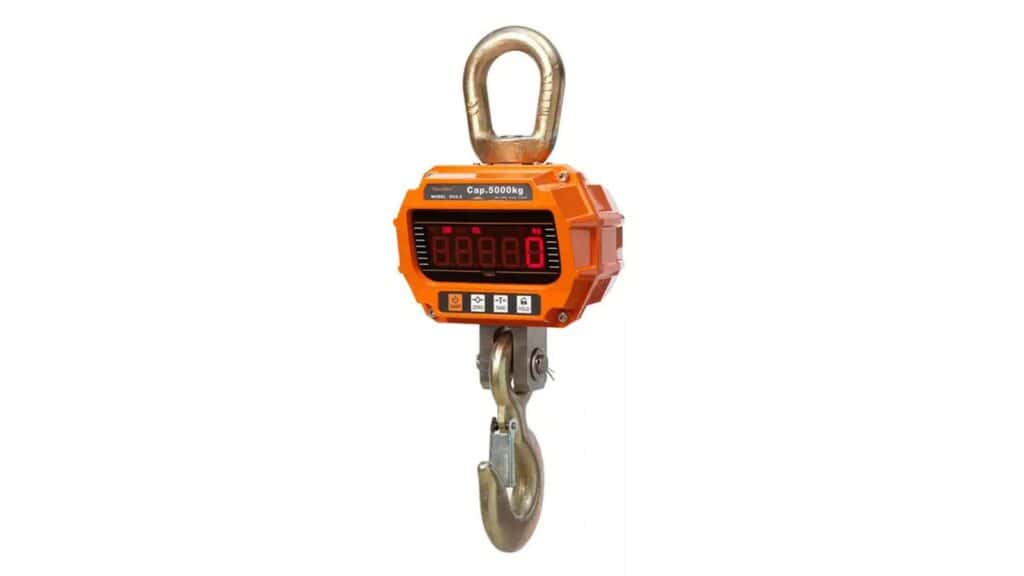
Digital crane scales measure suspended loads using an internal load cell and electronic sensors. They convert force into a digital signal and show weight on an LED or LCD screen. Many models support kilograms and pounds, with capacities that often range from 500 kg up to 30+ tons.
Their clear displays help crews read weight from a distance. Common features include tare, zero, peak hold, and overload alerts.
Most digital crane scales use a top shackle and bottom hook. This design supports vertical lifting and fast attachment. Their balance of accuracy, durability, and cost makes them the most common crane scales in daily industrial use.
Mechanical Crane Scales
Mechanical crane scales rely on springs or mechanical linkages instead of electronics. They display weight on a dial with a moving needle, which obviously does not need batteries or external power.
Workers use mechanical crane scales in simple or remote settings because they can handle rough conditions such as dust-heavy or wet areas.
However, the simple and rugged design also brings disadvantages. Their accuracy tends to be lower than digital crane scales. Reading the dial also takes more time and care. Because of these limits, many industries now use them only as backups or for basic lifting tasks.
Wireless Crane Scales
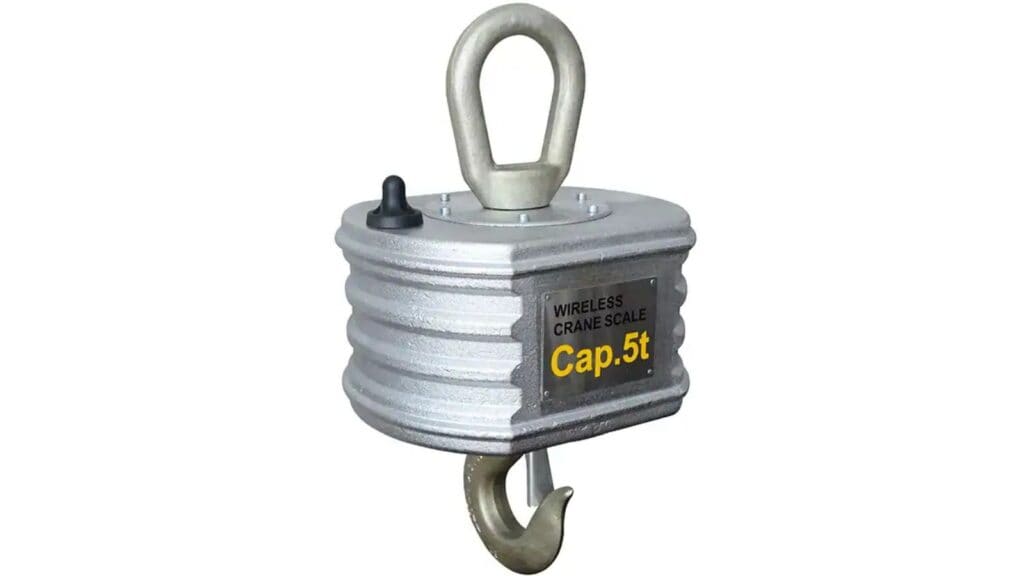
Wireless crane scales send weight data to a remote screen using RF or Bluetooth signals. The scale hangs on the load, while operators view readings on a handheld display, tablet, or control room monitor.
This setup improves safety in high-risk areas. Operators can stand away from the load and avoid overhead hazards. Wireless crane scales often support data logging, alarms, and multiple displays.
Crane Scale vs. Dynamometer: Key Differences and How to Choose
Many buyers confuse crane scales and dynamometers because both tools measure force on a suspended load. However, they are built for different jobs and test conditions.
A crane scale is mainly a weighing device. It measures the weight of a load hanging vertically from a crane or hoist and displays that value in mass units such as kilograms or pounds.
In contrast, a dynamometer is a force measurement tool. It measures tension or pull in any direction and usually displays the result in force units such as newtons or kilonewtons, although many digital models can also show weight.
Side‑by‑Side Comparison: Crane Scale vs. Dynamometer
| Aspect | Crane Scale | Dynamometer |
|---|---|---|
| Primary purpose | Weighing suspended loads | Measuring tension / pull force |
| Typical units | Kilograms, pounds | Newtons, kilonewtons, sometimes kilograms/pounds |
| Force direction | Vertical load, straight down from the hook | Any direction along the line of pull |
| Typical applications | Everyday lifting, load verification, shipping weights | Tension testing, proof loading, cable and rope tension checks |
| Use during lifting | Stays in the rigging while the crane lifts and moves load | Often used temporarily for test pulls or setup, then removed |
| Accuracy needs | High, but focused on practical lifting tolerances | Often higher, for engineering tests and certification work |
| Best for | Routine overhead lifts and weight checks | Engineering tests, tension control, and pull testing |
Use a crane scale when you need a simple, accurate weight reading on a load hanging mostly straight down from a crane or hoist, especially for routine lifting, shipping, or production work.
Use a dynamometer when you need to measure tension or pulling force in any direction, perform proof or pull tests, or do regular tension checks on ropes, cables, and anchors where higher precision and flexibility are required.
Essential Features to Consider
A crane scale must support safe lifting and precise weight measurement in real work settings. The most important features help remove extra weight, show clear readings, and stop unsafe loads before damage occurs.
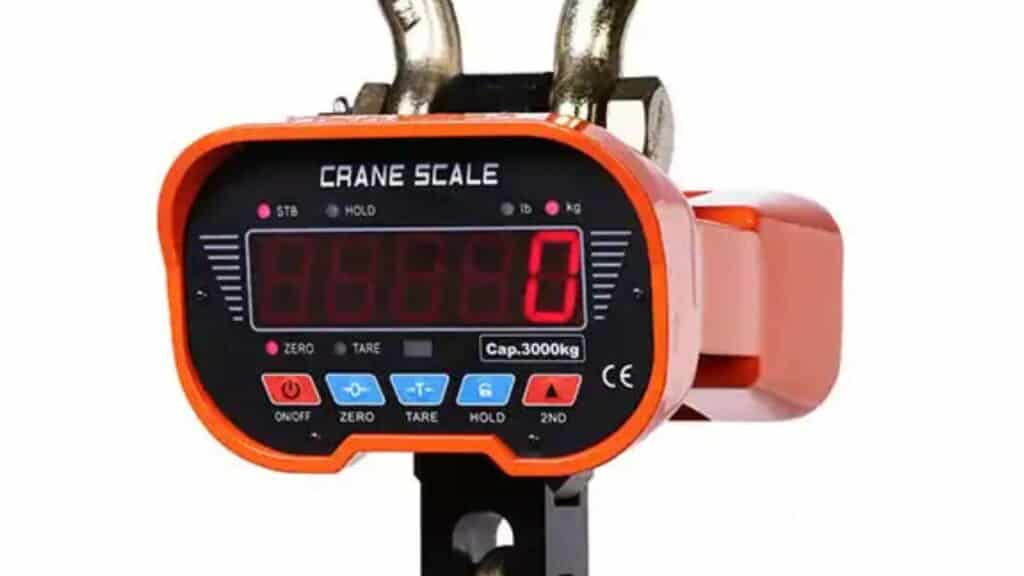
Tare Function
The tare function lets the operator subtract the weight of rigging gear, because chains, hooks, and slings add weight that does not belong to the load. Without tare, readings would be higher than the actual values, which reduces accuracy.
Using this function is rather straightforward: the operator hangs the rigging, presses Tare, and resets the scale to zero. The scale then shows only the true load weight.
Tare also improves safety. When the display shows only the load, crews can compare the reading to crane limits with confidence.
Hold Function
The hold function lets the scale freeze the current reading on the display so operators can read it safely, even after the load moves or is lowered. This helps when the load is high above eye level, swinging slightly, or only lifted briefly, because the operator can focus on safe crane control first and check the captured value afterward.
In many digital crane scales, the hold feature can work manually (press a button to lock the reading) or automatically (the scale detects a stable value and holds it).
This reduces misreads caused by movement, saves time on repeated lifts, and helps crews record weights accurately for documentation, billing, and quality control.
Display and Readability
A crane scale display must stay clear from a distance, becauce the loads tend to be high above the ground when operators try to read them.
Here, large digits matter more than fancy features. Bright LED displays work well indoors or in low light, while LCD displays perform better in direct sunlight outdoors.
| Display Type | Best Use Case |
|---|---|
| LED | Indoor, low light |
| LCD | Outdoor, bright light |
When choosing crane scales, remember angle and contrast also affect visibility. A tilted or low-contrast screen slows work and raises error risk.
Overload Protection
Overload protection helps prevent overloading and equipment damage. This feature warns the operator when a load nears or exceeds safe limits.
Most systems use visual alerts, sound alarms, or both. The warning triggers before the crane reaches its rated capacity. That early signal gives time to stop the lift.
Industrial Applications of Crane Scales
To wrap up the guide, this chapter will aim to give you some examples of applicable industries like the ones mentioned in the intro of this blog. The uses of the crane scales vary greatly in how they help crews confirm load weight, plan moves, and prevent overloading across different scenarios.

Manufacturing and Production
Manufacturing sites use crane scales to weigh raw materials, parts, and finished goods during lifts. The scale hangs from an overhead crane or trolley hoist and shows the load weight in real time. This setup lets operators adjust lifts before moving heavy items.
What’s more, digital crane scales often store readings, which helps with quality checks and production records.
Here are a few examples of the common applications:
- Weighing metal coils and castings
- Checking batch weights during assembly
- Verifying tool and mold weights before lifts
Shipping and Logistics
Warehouses and shipping yards rely on crane scales to confirm shipment weights before loading trucks or containers. The scale measures loads as forklifts or cranes lift pallets, crates, or bulk goods.
This process helps prevent overloaded vehicles from causing safety issues and fines. With crane scales, staff can split loads, adjust packing on the spot, and combine weigh and lift in one step, which reduces handling time.
Construction and Engineering
Construction crews use crane scales for material handling, like moving steel beams, concrete panels, and equipment. The scale confirms the load weight before the crane swings the item into place.
Preventing overloading matters on job sites with tight safety margins. Accurate weight measurement helps engineers match loads to crane capacity charts. This lowers the risk of crane strain or tip-over.
Frequently Asked Questions
Do I have to use a dynamometer for tension and pull testing? Can a crane scale take its place?
You should still use a dynamometer. A standard crane scale is designed for a load that hangs straight down. If you try to use it for sideways pull or tension testing, it will be put under forces it was not designed to handle. That can lead to inaccurate readings, long‑term damage, or sudden failure.
For any pull test, non‑vertical load, or tension adjustment task, you should rely on a dynamometer specifically rated for that kind of work. This protects your equipment, gives you correct data, and reduces the risk of overloading lines, anchors, or lifting points.
How does wind or load movement affect the crane scale reading?
Wind or a swinging load can cause dynamic forces that momentarily increase the measured weight, leading to inaccurate or fluctuating readings. For the most accurate result, the load should be as stationary as possible. Some advanced scales feature a “motion damping” or “averaging” function to stabilize the reading in such conditions.
Can I use a single wireless crane scale with a few remote displays?
Many wireless systems allow one transmitter (the scale) to connect to several receivers, such as a handheld remote, a fixed monitor in a control room, and a tablet. This enables multiple team members to view the weight simultaneously for coordination and safety.