
Turnbuckles have a rather self-evident name: it is used to buckle things, and you operate it by turning. But there is much more to learn about this piece of rigging equipment. In this article, we will provide you with practical information on their mechanism, the most common types and materials, their typical applications, as well as the selection and installation process.
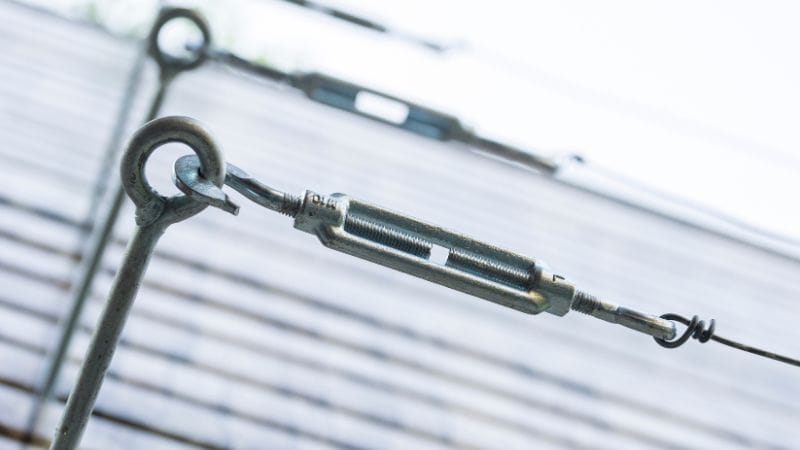
What a Turnbuckle Is and How It Works
Core Components
At its core, a turnbuckle is a three‑part system designed to adjust tension inline without introducing twist into the attached line:
- Central body (frame): An open or closed metal housing with internal threads on both ends.
- Two end fittings: Threaded components, commonly eyes, jaws, hooks, or specialized fittings, that connect the assembly to anchor points or to the line itself.
Those three pieces act as a compact, reversible screw jack. The end fittings thread into opposite ends of the body. Rotating the body draws both ends together (increasing tension) or pushes them apart (reducing tension). The result is smooth, controlled adjustment with the load staying in line.
Turnbuckle bodies come in two primary styles:
- Open‑body: The threads remain visible. This style is easy to inspect and lubricate, which is why it’s common in rigging and temporary setups.
- Closed‑body (often called bottle screws): The threads are enclosed by a tubular sleeve. This protects threads from contamination and offers a clean silhouette for architectural or marine applications.

Left‑ and Right‑Hand Threads
The trick behind a turnbuckle’s simultaneous movement is opposing threads. One end fitting uses a standard right‑hand thread; the other uses a left‑hand thread. When the body rotates, each end fitting advances in the opposite direction, so the assembly shortens or lengthens without spinning the connected cable or rod.
To identify the left-hand thread, manufacturers typically mark this end with a groove, notch, or an “L” on the body or fitting to ensure proper orientation during installation.
Size, Take‑Up Length, and Fit
Two critical mechanical specifications must be considered for proper turnbuckle function: thread geometry and adjustment range. First, the thread diameter and pitch must exactly match those of the mating components, such as an eye bolt or a stud. While a larger thread diameter generally corresponds to a higher working load limit, the definitive rating must always come from the manufacturer.
Second, sufficient take-up length—the total linear adjustment available from full extension to full closure—is essential. This range must be adequate to accommodate various factors including initial set, elastic stretch, long-term creep, thermal expansion and contraction, and installation tolerances. A common practice among installers is to initially set the turnbuckle near the middle of its adjustment range, thereby reserving ample capacity to either tighten or loosen the assembly as conditions require.
Different Types of Turnbuckles
Basic Turnbuckle & End Fittings
Turnbuckles are primarily categorized by their end fittings, which are a set of two fittings with a combination of eye, jaw, and hook.
Jaw end fitting: A U-shaped clamp that connects with a pin (like a bolt or shackle pin). This allows the connection to swivel, which is crucial if the anchor points aren’t perfectly aligned.
Eye end fitting: A closed loop. The eye end also connects with a shackle or pin, but it creates a fixed, non-swiveling connection. It’s used for permanent anchor points.
Hook end fitting: A curved piece for quick attachment to an eyelet or loop. It should be noted that hooks must always be secured with a safety latch or wire (“moused”) to prevent them from popping off under tension or vibration.

Here are the six standard turnbuckle types, based on the combinations of these ends.
| Type | Description & Best Use |
|---|---|
| Jaw & Jaw | The most common and versatile type. Ideal for general use where articulation is needed at both ends. |
| Eye & Eye | Creating a fixed, rigid connection between two permanent anchor points. |
| Hook & Hook | Temporary setups or applications requiring quick release. Requires safety latches. |
| Jaw & Eye | A hybrid setup. Use when you need a swiveling connection on one end (Jaw) and a fixed connection on the other (Eye). |
| Jaw & Hook | Connecting a permanent, swiveling point (Jaw) to a quick-release point (Hook). |
| Eye & Hook | Connecting a fixed anchor point (Eye) to a quick-release point (Hook). |
Common Materials for Turnbuckles
For durable and economical applications, carbon or alloy steel is a common choice, often finished with a hot-dip galvanizing process to add significant corrosion resistance. When superior corrosion resistance is required, particularly in harsh environments, stainless steel in grades 304 or 316 is the preferred material. For the most demanding applications that require an exceptionally high strength-to-weight ratio and the ability to maintain performance under extreme temperatures, specialty alloys are the optimal solution.
Where Turnbuckles Are Used
Construction and Structural Bracing
- Cable bracing in buildings: Turnbuckles sit in X‑bracing to plumb columns and square frames, providing adjustable tension that resists racking forces from wind and seismic loads.
- Architectural cable systems: Suspension bridge cable, guardrails, handrails, and façade cables use turnbuckles to set uniform tension, maintain aesthetics, and allow seasonal or service adjustments.
- Temporary positioning: On job sites, crews use turnbuckles to hold components in alignment before permanent fastening or welding, like thick curtain wall panels or steel members awaiting final torque.
Marine and Aviation Rigging
- Maritime and offshore: Ships use turnbuckles to tension lashing systems, secure deck cargo, and maintain standing rigging. On sailboats, closed‑body stainless “rigging screws” set mast stays and shrouds with high corrosion resistance.
- Aviation: Aircraft flight‑control systems employ specialized turnbuckles to set cable tensions within tight tolerances. Locking is mandatory, via safety wire, clips, or locknuts, to prevent any in‑service movement.
Load Ratings and Safety Factor of Turnbuckle
To ensure safety and performance, turnbuckles must be selected and used with careful attention to their specifications and the system they integrate with. The foundational concept is the Working Load Limit (WLL), which is the maximum load that should be applied in normal service.
Furthermore, a turnbuckle’s WLL must be considered in the context of the entire rigging system, which is only as strong as its weakest link. Consequently, the turnbuckle’s rating should be equal to or greater than that of all connected components in the rigging assembly, including the wire rope, cable, shackles, thimbles, and anchor points.
It is also critical to adhere to the intended loading direction, as turnbuckles are engineered for straight-line tension. If perfect alignment cannot be guaranteed, an alternative connection or a swivel may be necessary.
Installation and Adjustment
- Inspect components: Verify markings, WLL, thread compatibility, and the absence of cracks, deformation, or corrosion. Ensure pins, cotters, and shackles are on hand.
- Pre‑set the body: Thread both end fittings into the body to roughly the same depth, positioning the assembly near its mid‑take‑up. Identify the left‑hand side (groove, notch, or “L”).
- Align the system: Install the end fittings into their anchors (e.g., shackle to eye, jaw to plate). The turnbuckle should be in straight‑line tension with no bending or side load.
- Hand‑tighten: Remove slack by rotating the body by hand. Maintain equal thread engagement on both ends. Do not bottom out either fitting.
- Final tensioning: Use appropriately sized wrenches on the flats provided, or a bar through the body if designed for that purpose, to rotate the body. Increase tension gradually, checking alignment and thread exposure. For cable systems, measure tension using a calibrated gauge if required by spec.
- Lock the setting: Install jam nuts on the threads and tighten against the body. Where specified, add safety wire, lock plates, or cotter‑pinned clevis pins. For hooks, consider mousing/seizing to prevent unhooking in service.
- Recheck: After the initial load is applied (or after temperature cycles), recheck tension and locking hardware. Adjust if necessary.
There are also other safety concerns that workers should be aware of. Besides never exceed the working load limit, installer should also note that turnbuckles are primarily designed for tensioning applications, not as primary lifting components. While some are rated for such use, in most standard lifting and rigging plans, dedicated components are preferred due to safety and regulatory reasons.
Furthermore, hook ends should be avoided in situations where a loss of tension or vibration could lead to accidental disengagement. Finally, to prevent thread damage and the creation of stress risers that can compromise integrity, proper tools must always be used for adjustment, and the body or fittings should never be hammered on.
Explore More at Grandlifting
In essence, the turnbuckles are vital rigging hardware that shape the industry in spite of their mechanical simplicity. Its versatility ensures that for nearly any application requiring adjustable, in-line tension, there is a turnbuckle designed for it.
If you ever need these turnbuckles and other rigging equipment, you can find them right here at Grandlifting.com. Explore our certified selection of all types of turnbuckles and get expert advice today!
Frequently Asked Questions
Can I use a turnbuckle for a permanent installation?
Of course. Turnbuckles are commonly used in permanent installations like structural cable bracing in buildings and standing rigging on sailboats. The key is to select the correct material for the environment and ensure it is properly locked in place with jam nuts, safety wire, or other permanent locking methods to prevent any unintended loosening over time.
How often should I inspect and maintain a turnbuckle?
Inspection frequency depends on the application and environment. For safety-critical or high-vibration applications (like rigging or architectural systems), a visual check before each use is recommended.
For permanent installations, a formal inspection schedule should be established. Look for thread corrosion, deformation, cracks, and ensure locking devices are secure. Open-body turnbuckles may require occasional lubrication, while closed-body types are generally maintenance-free but should be checked for external damage.
Can I repair a damaged turnbuckle, or should I always replace it?
Replacement is always the safest course of action. Turnbuckles are crucial load-bearing components, and repairing a bent, cracked, or heavily corroded one is not advisable. Damage can create hidden stress points that compromise the entire assembly’s integrity. If any part of a turnbuckle is damaged, it should be uninstalled as soon as possible and replaced with a new, certified unit.
Are there situations where using a turnbuckle is not recommended?
Yes. You should avoid using turnbuckles in applications with high shock loads or intense, rapid vibration, as these can cause locking mechanisms to fail. They are also not suitable for compressive loads (as a push rod) or where significant side-loading is present. In dynamic lifting applications, dedicated load-rated components should be used instead of a standard turnbuckle not explicitly designed for that purpose.