
From ship decks and construction sites to climbing gyms and dog parks, snap hooks fulfill their duty as universal rigging tools for many industries. In this guide, we will offer you a quick break down of the anatomy, materials, types, specifications, and best practices for sanp hooks, so you can make informed decisions when purchasing or using this rigging equipment.
What Is a Snap Hook?
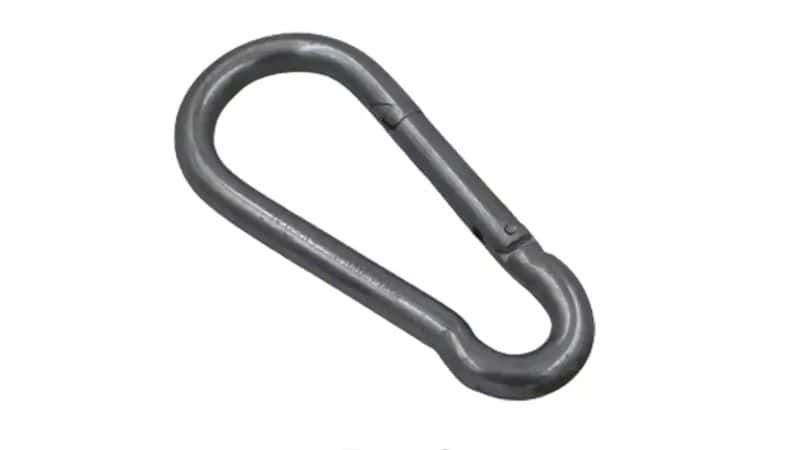
The Basic Anatomy
A snap hook is a connector device with a hook-shaped body and a spring-loaded gate that opens under pressure and snaps shut automatically when released. This simple mechanism provides a quick, dependable way to connect lines or gear without tying knots or threading hardware. The automatic closure helps prevent accidental disengagement under normal service, provided the hook is correctly oriented and not overloaded.
Common Materials
Stainless steel offers great corrosion resistance and a long service life. This is especially true for grades like 304 or the more highly alloyed 316, which offer enhanced protection in harsh, saline environments. Its durability ensures reliability over many years with minimal maintenance.
Brass is frequently selected for applications where both aesthetics and functionality are important. It accepts decorative finishes well and performs reliably in hot or non-sparking environments. Its heat tolerance and inherent corrosion resistance make it versatile for both visible architectural details and specialized industrial contexts.
For a cost-effective solution that doesn’t sacrifice performance, die-cast zinc is a common option. Being a relatively lightweight metal, it provides a favorable strength-to-weight ratio, which contributes to a positive user experience.
Key Components and Anatomy
The Body and Spine
The body is the load‑bearing frame of the snap hook. Its spine, typically the long, straight or gently curved back, carries the majority of the load along the hook’s designed axis. The throat is the opening into the hook, and the eye (at the base) is where rope, chain, or webbing attaches. Eyes may be fixed or swivel, and some include a captive bar to keep attachments from escaping or shifting into an unsafe orientation.
The Gate Mechanism
The gate is a spring‑loaded bar that pivots on a hinge pin. Pressing the gate opens the throat, and releasing it lets the spring snap the gate closed. Non‑locking gates rely solely on spring tension, while locking designs add a sleeve or mechanism that must be deliberately actuated (double‑action or triple‑action) to open.
Different Types of Snap Hooks

Non-Locking vs. Auto-Locking
Non‑locking snap hooks use a simple spring gate. They’re quick and convenient for low‑risk tasks that do not support people or critical loads. By contrast, auto‑locking snap hooks include a self‑closing, self‑locking gate, typically requiring two or three deliberate actions to open, and are often mandated in life‑safety and fall‑protection systems. In those environments, standards commonly require locking connectors to help prevent rollout (unintentional gate opening due to contact with another component) and to maintain security even if the gate is bumped.
Common Shapes and Configurations
There are different designs for snap hooks that aim for various functions:
- Fixed-eye snaps: The eye is rigidly connected to the body. Common in boating and general rigging where consistent orientation is helpful.
- Swivel-eye snaps: A rotating eye reduces twist and tangling in ropes, chains, or straps, improving handling and longevity.
- Panic snaps: Designed for rapid release under tension, often used in animal handling where a fast disconnect may be needed.
Critical Specifications
Working Load Limit (WLL)
The working load limit is the maximum load that a snap hook is rated to carry in service. It is intentionally set well below the device’s minimum breaking strength by applying a safety factor (often 4:1, 5:1, or as specified by applicable standards). Users should never exceed the WLL. For example, if a connector’s minimum breaking strength is 22 kN (~4,946 lbf) and a 5:1 safety factor is applied, its WLL would be roughly 989 lbf. Always consult the manufacturer’s data sheet, branding, size, material, and intended use all affect ratings.
Understanding Load Axes
Snap hooks are engineered to be loaded along the major axis, generally in line with the spine. Side‑loading, cross‑loading, or loading across the gate can dramatically reduce capacity and can even lever the gate open. Dynamic forces (shock loads) can also exceed ratings even when the static load is within the WLL. For life‑safety connectors, modern standards call for robust gate and face strengths, but users should still orient the hook to avoid prying forces, tri‑axial loads, or conditions that encourage rollout.
Using Snap Hooks Safely
- Verify the WLL and ensure it exceeds the maximum expected load with an appropriate safety factor.
- Match the connector to the application: material, gate type (locking vs. non‑locking), and eye configuration.
- Load along the major axis: avoid side‑loads, cross‑loads, and gate‑face loading.
- Inspect before each use for corrosion, cracks, deformation, sharp burrs, gate misalignment, and sluggish springs. Retire questionable hardware.
- Control the environment: consider corrosion, heat, chemicals, and abrasion, and choose finishes and materials accordingly.
- For fall protection and overhead tasks, follow applicable standards and manufacturer instructions without exception.
Common Applications
Lifting and Hoisting
In rigging, snap hooks secure slings, chains, or wire rope to lift points, spreader bars, or anchor eyes. However, you should acknowledge that overhead lifting typically requires purpose‑built heavy-duty hooks with safety latches that meet relevant ASME/ISO standards and clearly marked WLLs. Therefore, you should not substitute a utility snap hook for an overhead‑lifting hook, unless the manufacturer states the hook is certified for that service.
Swivel‑eye designs can reduce twisting under lift, and fixed‑eye models help maintain consistent alignment. For example, fixed-eye hooks can be used on construction sites to connect a chain sling directly, and lift and place heavy loads like lugs of pre-cast concrete panels with great precision. The fixed design ensures the hook maintains perfect alignment with the lug, preventing side-loading.
Fall Protection Systems
Safety harnesses, lanyards, and anchorage connectors form a critical lifeline, and their connections are most often made with auto‑locking snap hooks. These hooks are tailored to specific tasks and anchorage points. For instance, wide‑throat “rebar” hooks are engineered with a broad, U-shaped gap to securely and efficiently clip directly onto large structural members like steel I-beams, rebar cages, or scaffolding. In contrast, standard locking hooks, with their narrower profile, are designed for connecting to the standardized D‑rings on a worker’s harness or to fixed anchorage points. For labor-intensive work environments like construction, manufacturing, and the marine industry, this specialized safety rigging is the key countermeasure against fall hazards.

Because the lives of workers are on the line, compliance frameworks for fall protection snap hooks pay significant attention to safety. They mandate features like self‑closing and self‑locking gates to prevent accidental disengagement, adequate gate and face strength to withstand sudden loads, and minimum tensile strength for all connectors.
Conclusion: Selecting the Right Tool
While the snap hook is simple in structure, its application demands careful consideration. Not all snap hooks are created equal, and selecting the correct one is a matter of matching its specific type, material, and rated capacity to the demands of the task and the potential consequences of failure.
Remember, making an informed choice when using snap hooks ensures not only the success of the operation but, in many cases, the preservation of life and limb.
Frequently Asked Questions About Snap Hooks
What Is the Difference Between a Snap Hook and Carabiner?
Snap hooks typically have a hook profile with a spring or auto‑locking gate and are common in rigging, marine, and lanyards. Carabiners are oval-shaped connectors widely standardized for climbing and rescue. Choose certified, locking carabiners for life safety. For general utility, pick a snap hook with adequate WLL, a compatible eye/throat, and corrosion‑appropriate material.
How do I size a snap hook for my rope, webbing, or anchor?
Match dimensions to your system. Ensure the throat opening fits the anchor or attachment without forcing. Choose an eye size or slot width that accommodates rope diameter or webbing width without binding. Confirm the WLL exceeds maximum loads with a safety margin. Use swivel‑eye hooks to reduce twist; verify compatible shapes to avoid rollout.
Is it safe to connect two snap hooks together if both are rated for the load?
Connecting two snap hooks directly creates a three-way loading point that can induce side-loading and cross-loading on both hooks. This configuration dramatically increases the risk of “rollout,” where the gates can be levered open against each other under movement or load. It also creates a point where the load can be applied to the weaker gate or nose of the hook instead of its strong spine. The correct practice is to use a single, appropriately rated shackle, master link, or other dedicated rigging component to join two connections.