
Chains are the backbone of lifting rigging at trucking, construction, and industrial worksites. They may look similar on a shelf, but different grades, like G70 and G80, are built for completely different jobs. Using one where the other belongs creates real risk, including load failure, regulatory violations, and liability exposure.
Therefore, this guide aims to explain the ins and outs of the two grades and help fleet managers, riggers, and equipment operators to make better chocies when procuring their chains for practical applications.
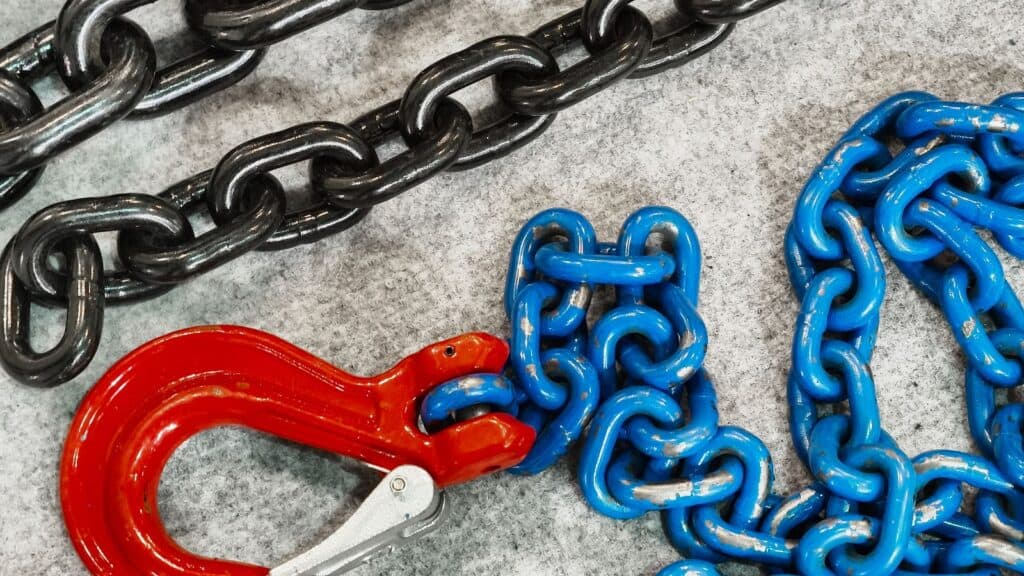
G70 vs G80: What Each Grade Is Actually Made For
G70 and G80 chains serve distinct roles dictated by their steel composition and regulatory approvals.
While G70 is a robust carbon steel chain perfect for static tie-down tension, it lacks the flexibility to handle the dynamic shock loads of overhead lifting.
G80, on the other hand, is an alloy steel chain engineered with specific elements (like manganese and silicon) to provide high tensile strength and crucial ductility—meaning it can absorb energy and stretch safely if a suspended load shifts.
Here is a quick breakdown of what separates the two grades:
| Feature | G70 (Transport Chain) | G80 (Alloy Lifting Chain) |
|---|---|---|
| Primary Applications | Cargo securement, towing, logging, oil field | Overhead lifting, lifting slings, cargo securement |
| Regulatory Compliance | FMCSA / DOT (Tie-down standard) | OSHA / ASME B30.9 (Lifting standard) |
| Behavior Under Load | High strength for static loads, but lacks ductility | High energy absorption; stretches under dynamic stress |
| Overhead Lifting? | Never approved | Approved (only Minimum grade) |
Strength Ratings That Matter In Real Use
Strength ratings are only useful when they are applied correctly, and the gap between working load limit and breaking strength has direct consequences for load safety.
Working Load Limit Vs Breaking Strength
- Working load limit (WLL): It is the maximum load a chain is rated to carry under normal, intended use. It is the number operators should reference when rigging or securing a load.
- Breaking strength: This refers to the force at which a chain will fail under a destructive test. It is always significantly higher than the WLL.
Both G70 and G80 chains are manufactured with a 4:1 safety factor—meaning their minimum breaking load is at least four times their WLL.
Crucial Safety Note:
1. The gap between the two parameters is not a buffer to use. It is the safety factor, and it exists to account for shock loading, wear, and chain angle.
2. You cannot substitute the two chain grades even with similar raw breaking strengths. What makes G80 legal for lifting is not just its WLL, but the fact that it is individually proof-tested and certified for overhead loads, whereas G70 is not.
WLL, MBL, MBS, And Minimum Breaking Load Explained
These terms appear on spec sheets and compliance documents and are often used interchangeably, though they carry slightly different technical meanings.
| Term | Full Name | What It Means |
|---|---|---|
| WLL | Working Load Limit | Maximum rated load for normal use |
| MBL | Minimum Breaking Load | Lowest acceptable breaking force under test |
| MBS | Minimum Breaking Strength | Same concept as MBL; often used in lifting specs |
| TS | Tensile Strength | Ultimate resistance to being pulled apart |
Minimum breaking load and minimum breaking force are the values a chain must meet or exceed during proof testing to pass a given grade standard.
How Chain Size Affects Capacity
WLL increases with chain diameter, but not in a simple linear ratio. The relationship between link cross-section and load capacity means a small increase in diameter produces a significant jump in strength.
| Chain Size | G70 WLL (lbs) | G80 WLL (lbs) |
|---|---|---|
| 1/4 inch | 3,150 | 3,500 |
| 5/16 inch | 4,700 | 4,500 |
| 3/8 inch | 6,600 | 7,100 |
| 7/16 inch | 8,760 | 10,000 |
| 1/2 inch | 11,300 | 12,000 |
| 5/8 inch | 15,800 | 18,100 |
Selecting a chain size based on the load weight and required WLL is the first step. The entire assembly, including hooks, shackles, and binders, must be rated to match or exceed the chain’s WLL.
G80 vs G70 Chain: Materials, Ductility, and Finish Differences

The manufacturing processes for G70 and G80 dictate how they behave under stress. These differences are structural, not just cosmetic.
- Carbon Steel vs. Alloy Steel: G70 chain is made from carbon steel, which excels at holding static tension (ideal for tie-downs). G80 incorporates alloying elements like manganese and silicon to handle dynamic stress, allowing it to absorb and distribute shock loads safely during overhead lifts.
- The Importance of Ductility: While both grades are heat-treated, G80’s process is optimized for ductility. If overloaded, a G80 chain will visibly stretch and deform before breaking, giving operators a critical warning. G70 is harder but less ductile, meaning it can fracture suddenly without warning under impact loads.
- Visual ID and Corrosion Resistance: G70 features a signature gold chromate finish, making it instantly recognizable on a job site while providing basic rust protection. G80 typically uses a black oxide or powder-coated finish for better durability in harsh conditions.
However, neither grade is suited for highly corrosive settings. In marine or chemical environments, you must use specialized finishes or stainless steel.
Standards and Compliance Rules to Know
The safety standards governing G70 and G80 chains are not interchangeable. Each grade aligns with a specific regulatory framework, and your use case dictates which rules apply.

ASTM, NACM, OSHA, and ASME Basics
In the U.S., ASTM and NACM define the material, testing, and performance specifications for chain manufacturing. For worksite safety, OSHA directly references ASME B30.9, which mandates Grade 80 as the minimum chain grade for overhead lifting slings. Using a grade 70 chain for an overhead lift is a direct violation of OSHA regulations. To be legal for lifting, a G80 chain must meet both ASTM testing and NACM dimensional specifications.
DOT Rules For Load Securement
The U.S. Department of Transportation (DOT), via FMCSA regulations, governs commercial cargo securement. Under these rules, G70 is the recognized standard for flatbed and heavy-haul tie-downs. Operators must use a chain with legible WLL markings and ensure the combined WLL of all tie-downs meets or exceeds the load weight. It is important to note that while G80 chain exceeds DOT standards and is fully compliant for securement, G70 cannot “cross over” to meet lifting standards.
EN 818 and EN 818-2 for Lifting Chains
EN 818 is the European standard series for short-link lifting chains, with EN 818-2 specifically covering alloy steel chains (like G80). While U.S. operations rely heavily on ASME/NACM, EN 818-2 is crucial for internationally sourced equipment or projects requiring European specifications. To be fully compliant in mixed-standard environments, imported lifting chains should carry EN 818-2 certification alongside NACM-equivalent proof testing documentation.
Building Safe Assemblies: Slings and Binders
A chain is only as strong as the hardware attached to it and the way it is configured. Whether you are lifting overhead or tying down a flatbed, every component in your assembly must match the chain’s capacity.
- Configuring G80 Lifting Slings: When using G80 chain for overhead lifts, the sling angle is critical. As the sling angle from vertical decreases, the tension on each chain leg significantly increases. Always refer to the sling’s identification tag, which clearly states the precise WLL for single-leg, two-leg, and multi-leg configurations. Never exceed these tagged limits.
- Pairing G70 with Load Binders: For cargo securement, your load binders must be rated for the exact chain size and WLL. If a binder is rated lower than the chain, it becomes the dangerous weak point of the assembly. While lever binders are the standard choice for most flatbed tie-downs, ratchet-style binders offer more controlled, precise tensioning. Always verify that the binder’s WLL matches or exceeds the chain’s WLL before hitting the road.
How to Identify Grade Markings on Your Chain
You should never have to guess a chain’s grade. Reputable manufacturers stamp grade and traceability markings directly onto the chain links at regular intervals.
Before putting any chain into service, verify the following stamps:
- G70 Markings: Look for “G7”, “70”, or “T” (Transport).
- G80 Markings: Look for “G8”, “80”, or “A8” (Alloy).
Safety Rule: Established manufacturers will also include a traceability code alongside the grade mark (linking it to batch and proof-test records). If a chain has no visible markings, you should not put it into service.
How G70 and G80 Compare to Other Chain Grades

G70 and G80 sit in the middle of a broader chain grade spectrum. Knowing your alternatives ensures you aren’t overspending or under-speccing for your application:
- Grade 30 (Proof Coil) & Grade 43 (High Test): These are general-purpose, lower-carbon chains used for light-duty towing, logging, and static loads. They are highly cost-effective but fall below the WLL and approval levels required for heavy DOT transport (G70) or overhead lifting (G80).
- Grade 100 & Grade 120 (Premium Lifting): These high-performance alloy chains meet the same ASME B30.9 lifting standards as G80, but offer significantly higher capacities. Grade 100 chains carry a WLL about 25% higher than G80 of the same size. This allows riggers to use a smaller, lighter chain for heavy loads, improving ergonomics.
Source High-Quality Chains and Rigging Hardware with Grandlifting
Choosing the correct chain grade keeps your crew safe and your operations fully compliant. Whether you need reliable G70 transport chains to secure a heavy-haul fleet or certified G80 alloy chains for critical overhead lifts, Grandlifting has you covered.
We manufacture and supply a comprehensive range of premium chain grades and a complete lineup of fully rated, compatible accessories, including load binders, lifting hooks, shackles, and custom chain slings.
Ready to upgrade your rigging gear? Browse our extensive catalog of lifting and rigging equipment, or contact our expert team today for customized solutions and bulk pricing!
Frequently Asked Questions
Are Grade 70 and Grade 80 chains interchangeable with the same hooks and fittings?
Not automatically. Hardware must be rated to match the chain’s WLL and must be compatible with the chain link dimensions. A G80 chain used in a lifting application requires hooks, shackles, and other fittings that are also rated for overhead lifting. Mixing grades and hardware without verifying WLL compatibility creates a compliance and safety risk.
How do durability factors like wear resistance and elongation compare between Grade 70 and Grade 80 chains?
Grade 80 alloy steel chain offers higher tensile strength and better ductility than Grade 70 carbon steel chain, which means it can absorb more energy before failure and gives more visible warning, through elongation, before breaking.
Grade 70 carbon steel chain has slightly lower elongation values and is more susceptible to fatigue under repeated dynamic loading. For applications involving repeated lifting cycles, G80 is the more durable long-term choice.