
Warehouses are one of the most intensive scenarios for good transports, and human labor often does not suffice, that is why warehouse lifting equipment is introduced. But the problems for managers and procurement teams are: How do they work exactly, and what should I consider when choosing them?
Our guide will break down all the main categories, explain how to match them to onsite work conditions, and cover the safety and cost factors that affect long-term value to help you make proper decisions.
How Lifting Systems Support Warehouse Workflows
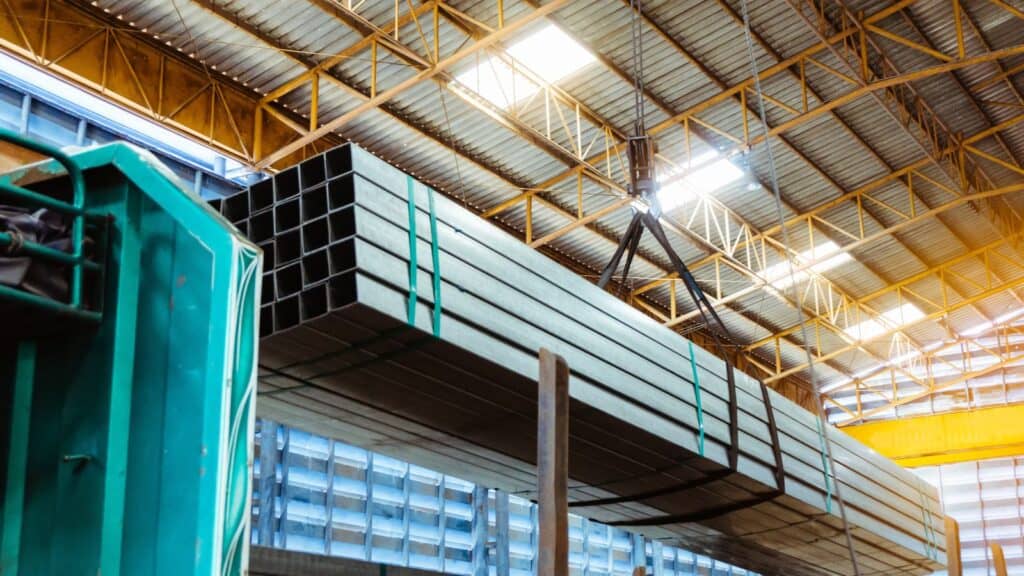
Lifting equipment connects every stage of warehouse work.
- Inbound freight needs to be unloaded and moved to storage.
- Inventory must be placed at height and retrieved on demand.
- Outbound orders require picking, staging, and loading.
Each of those tasks involves raising or lowering goods, sometimes a few inches off the floor, sometimes 30 feet into racking. The right lift equipment reduces the time and labor each movement takes while keeping operators safe.
Material handling systems also affect throughput. Faster lift and lower cycles, quicker travel speeds, and fewer bottlenecks at aisle intersections all tie directly to the equipment in use.
Main Warehouse Lifting Equipment Types and Their Uses
Each type of warehouse lift equipment is designed around a specific task profile and hence should be used according to such tasks. Here are the seven main categories and what they should be used for.
Forklifts for General Pallet Movement
Forklifts remain the most common powered lift in warehouse operations. A standard counterbalance forklift lifts palletized loads with two forks and uses a rear-mounted counterweight for stability. However, the bulk of forklifts limits their ability to fit into narrow aisles compared to other lightweight tools like pallet trucks.
Forklifts handle dock unloading, put-away to standard racking, and floor-level transport across large facilities. Electric models suit indoor use due to zero emissions and quieter operation, while internal combustion (IC) models powered by propane, diesel, or gas are common in outdoor yards or facilities with adequate ventilation.
Stackers and Pallet Stackers for Tight Spaces
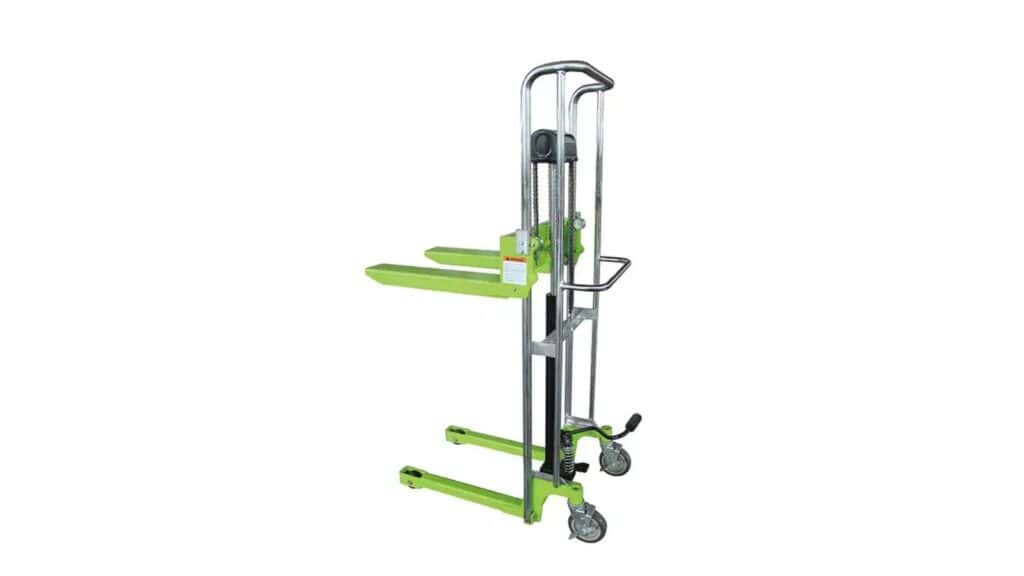
Pallet stackers bridge the gap between manual pallet jacks and full-size forklifts. They lift loads vertically for stacking on racks or shelves, typically up to 15 feet, while occupying a much smaller footprint.
Powered pallet stackers work well in backrooms, cold storage, and facilities where aisle widths drop below eight feet. They are a cost-effective option for operations that need occasional stacking but cannot justify a full forklift fleet.
Scissor Lifts and Lift Tables for Vertical Access and Ergonomics
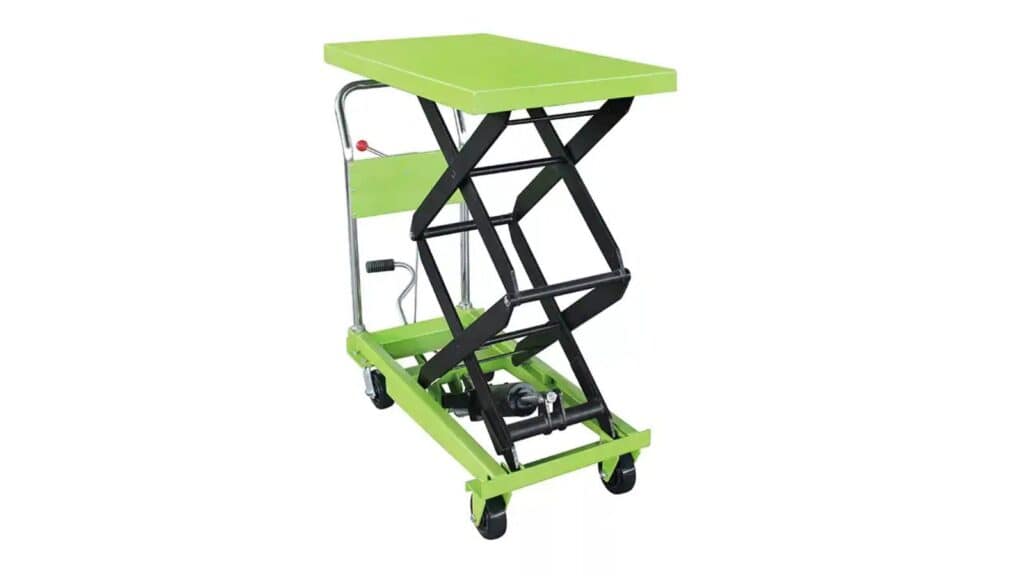
Scissor lifts provide a stable elevated platform for workers who need to access high storage, signage, lighting, or maintenance points. They move vertically in place and are available as mobile self-propelled units or stationary models.
Lift tables serve a different purpose. They raise or lower loads to an ergonomic working height, reducing bending and strain for workers at packing stations, assembly areas, or dock edges. Standard lift tables handle loads from a few hundred pounds to over 10,000 pounds.
Both scissor lifts and lift tables reduce repetitive motion injuries and improve work speed at fixed locations.
Chain Hoists for Fixed-Point Heavy Lifting
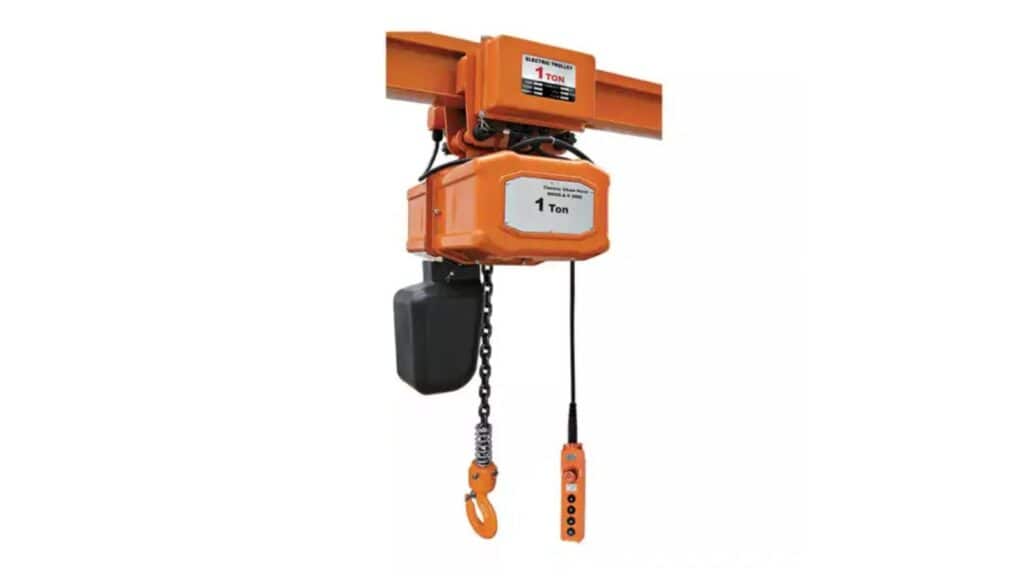
Chain hoists attach to overhead beams, gantries, or jib cranes. They lift heavy or awkward loads straight up using a chain and gear mechanism. Manual, electric, and pneumatic versions are available.
Common warehouse applications include:
- Lifting machinery or equipment during maintenance
- Moving heavy dies, molds, or tooling
- Loading and unloading items too heavy or bulky for a forklift
Electric chain hoists with capacities from one-half ton to several tons are the most common in warehouse settings. They provide precise vertical control and keep the load path predictable.
Walkie Stacker Options for Light to Mid-Duty Tasks
A walkie stacker is a walk-behind powered stacker. The operator controls it from behind using a tiller handle. These machines typically handle loads between 1,000 and 4,000 pounds and lift to moderate heights.
Walkie stackers suit small warehouses, retail backrooms, and staging areas near docks. They are easy to learn, simple to maintain, and take up minimal floor space when parked. Lithium-ion battery models now offer faster charging and longer run times compared to traditional lead-acid options.
Reach Trucks for High-Density Racking
Reach trucks are built for narrow-aisle racking systems. They feature extendable mast carriages or pantograph mechanisms that allow the forks to reach into deep rack bays without the truck body entering the aisle.
Reach trucks are almost always electric. They excel at vertical storage density and are standard in distribution centers where maximizing cube utilization matters.
Order Pickers for Case and Each Picking
Order pickers elevate the operator along with the load. The worker rides a platform that rises to the pick face, selects items, and places them on the platform or a pallet below.
Low-level order pickers handle picks up to about 12 feet. High-level order pickers reach 30 feet or higher, making them essential in facilities with tall racking and high SKU counts. Wire-guided or rail-guided systems keep high-level machines centered in the aisle for added safety.
How to Match Equipment to Load, Height, and Space
Selecting warehouse lift equipment requires aligning three variables: what the load weighs, how high it needs to go, and how much room the machine has to operate. Getting any one of these wrong leads to safety hazards, wasted capital, or operational slowdowns.
Choosing Based on Lifting Capacity
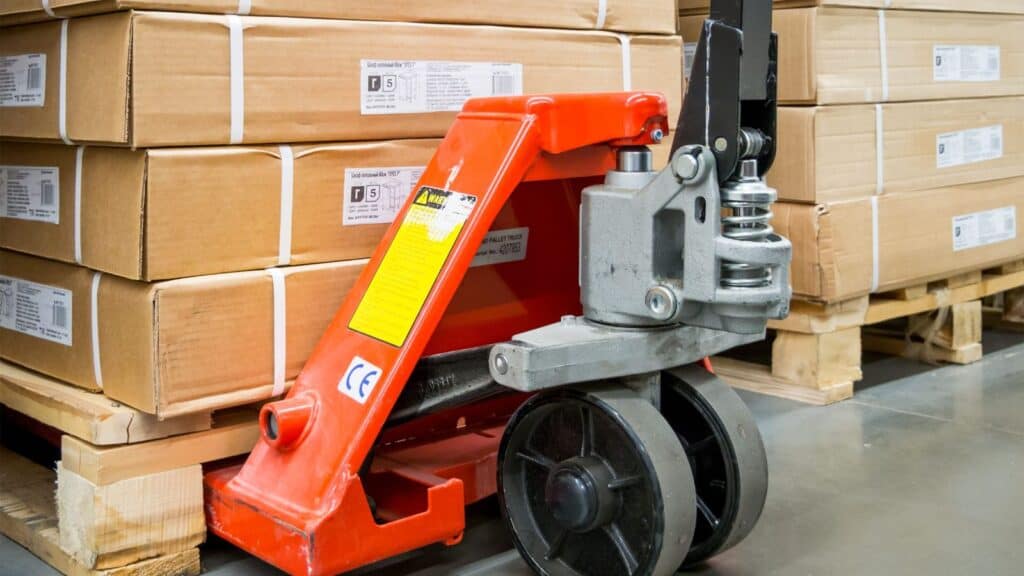
Every lift machine has a rated capacity, and that number is not just a suggestion. Operators must never exceed it.
It should be noted that when loads are heavier or have an unusual center of gravity, the effective capacity drops.
For heavy-duty lifting above 10,000 pounds, purpose-built heavy-duty forklifts or overhead hoists are the right choice.
For lighter tasks under 4,000 pounds, walkie stackers or powered pallet stackers often provide a better fit at lower cost.
Quick capacity guidelines:
- Under 2,000 lbs: Manual or powered pallet jacks, light stackers
- 2,000 to 5,000 lbs: Standard forklifts, reach trucks, powered stackers
- 5,000 to 10,000 lbs: Standard to mid-range forklifts
- Over 10,000 lbs: Heavy-duty forklifts, chain hoists, overhead cranes
Working Around Aisle Width and Rack Height
Aisle width determines which machines can operate safely. Standard forklifts need 12-foot aisles or wider. Reach trucks work in aisles as narrow as 8 to 10 feet. Walkie stackers and order pickers can operate in even tighter configurations.
Rack height matters just as much. A facility with racking at 25 feet or above needs reach trucks or high-level order pickers. Standard counterbalance forklifts typically top out around 15 to 20 feet and become less stable as they approach their maximum lift height.
Selecting Equipment for Pallets, Bulky Loads, and Irregular Items
Standard palletized loads are the simplest case. Forklifts and stackers handle them with standard forks. But long or bulky items, such as lumber, pipe, or carpet rolls, may require side loaders or specialized fork attachments.
Irregular items that cannot sit on a pallet may need a hoist, vacuum lifter, or custom fixture. Matching the attachment or machine to the load shape prevents damage and reduces handling time.
Balancing Throughput, Maneuverability, and Operator Needs
High-volume operations prioritize speed and cycle time. Faster travel speeds and quicker mast raise/lower cycles translate to more pallets moved per hour.
Tight facilities prioritize maneuverability. Articulated forklifts, reach trucks, and narrow-aisle stackers turn in less space but may sacrifice some speed.
Operator comfort also factors in. Stand-up trucks reduce fatigue on short-distance, high-frequency routes. Sit-down forklifts suit longer travel distances. Ergonomic features like adjustable steering columns and suspension seats affect productivity over a full shift.
Safety and Cost Factors of Warehouse Material Handling Equipment
Safety Features of Lifting Equipment
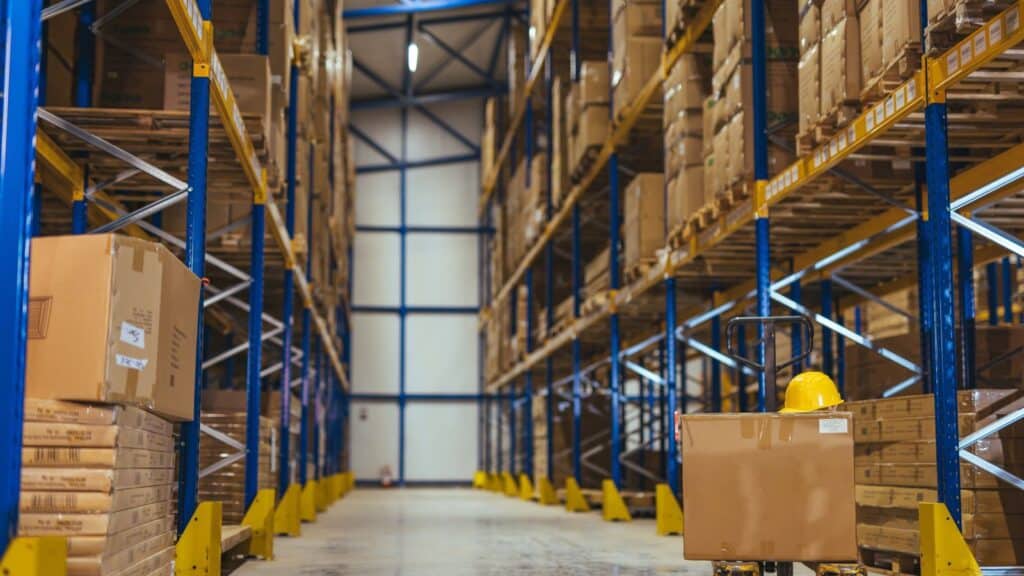
Warehouse lifting equipment introduces serious hazards when used incorrectly or not maintained properly. Tip-overs, struck-by incidents, and falls from elevated platforms rank among the most common causes of warehouse injuries.
To prevent such accidents, modern material handling machinery includes built-in safety features. Key features to look for include:
- Load backrest extensions to stop materials from sliding toward the operator.
- Overhead guards on forklifts and high-level order pickers to protect against falling objects.
- Automatic speed reduction that engages during tight turns or when the mast is elevated.
- Guardrails and interlocked gates on scissor lifts and lift platforms to prevent falls.
- Overload warning systems that immediately alert operators before the rated capacity is exceeded.
Total Cost of Owning Warehouse Lifting Equipment
The purchase price is only one part of the cost equation for warehouse lifting equipment. Power source, battery or fuel management, maintenance requirements, and expected service life all shape the total cost of ownership over a five- to ten-year lifespan.
Choosing equipment from established manufacturers often provides better access to replacement parts and qualified service technicians. Brands with broad dealer networks typically offer faster turnaround times, keeping your operations running smoothly.
Ultimately, machines with a lower upfront cost may carry a higher maintenance burden over time. Running total-cost comparisons across the expected ownership period can offer a much clearer picture than comparing sticker prices alone.
Common Warehouse Scenarios and Recommended Setups
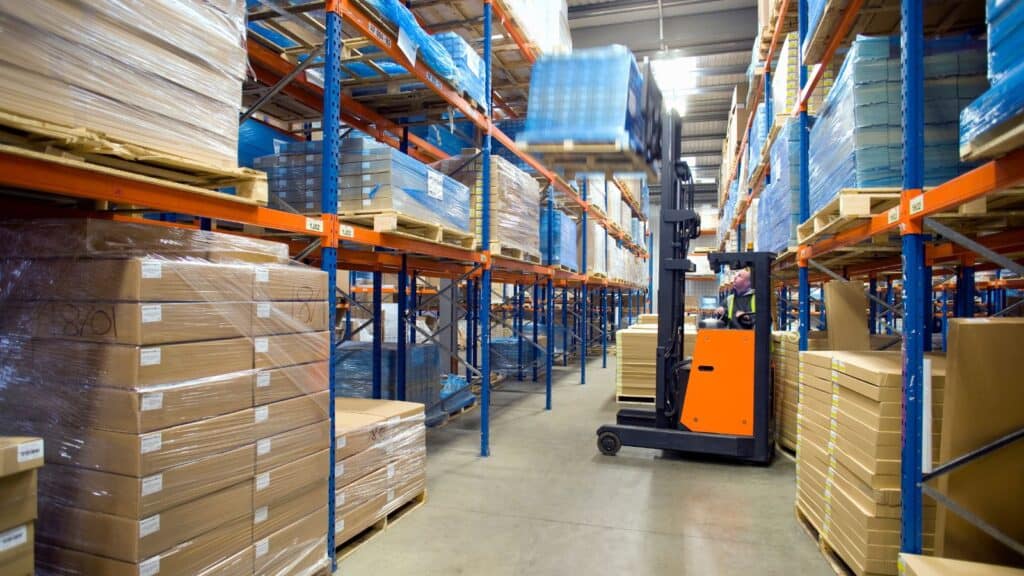
Different facility types call for different equipment mixes. The best approach is to start with the specific tasks performed daily, then select the smallest and most cost-effective machines that meet load, height, and throughput requirements.
Small Warehouses and Backroom Operations
Facilities under 10,000 square feet with moderate inventory levels often get by with a simple setup that keeps costs low and avoids the space demands of full-size forklifts:
- Walkie stacker for pallet stacking up to 10 to 12 feet
- Manual or powered pallet jack for floor-level transport
- Lift table at packing or shipping stations for ergonomic load positioning
High-Volume Distribution Centers
Large DCs handling thousands of pallets per day need a layered fleet:
- Counterbalance forklifts for dock receiving and shipping
- Reach trucks for put-away and replenishment in narrow-aisle racking
- High-level order pickers for case and each picking in tall racking zones
- Conveyor integration to move picked orders to packing and sorting
Fleet sizing depends on order volume, shift structure, and peak season demands.
Dock, Mezzanine, and Maintenance Applications
Loading docks benefit from dock lifts or scissor lifts that bridge height differences between truck beds and warehouse floors. Mezzanine operations often use vertical reciprocating conveyors or hydraulic lift tables to move goods between levels.
Maintenance teams rely on boom lifts or scissor lifts for overhead work and chain hoists for positioning heavy components. These fixed or semi-fixed tools serve targeted needs that mobile equipment cannot safely address.
Operations Handling Heavy or Repetitive Loads
Facilities that process heavy machinery, steel, or bulky assemblies need heavy-duty lifting solutions. Heavy-duty electric chain hoists mounted on overhead bridge cranes or jib cranes handle loads that exceed forklift capacity or require precise vertical placement.
For repetitive lifting at workstations, ergonomic lift tables and vacuum lifters reduce operator fatigue and injury risk. These tools pay for themselves through lower workers’ compensation costs and higher sustained productivity across shifts.
Upgrade Your Warehouse Operations with Grandlifting
Equipping your facility with the right machinery is the most effective way to boost throughput, protect your workforce, and optimize your bottom line. At Grandlifting, we supply a comprehensive range of industrial-grade lifting solutions—from heavy-duty chain hoists to ergonomic lift platforms—engineered to meet the highest safety and performance standards.
Ready to build a safer and more efficient warehouse? Browse our extensive equipment catalog or contact our material handling experts today for a customized solution tailored to your facility’s unique demands.