
A snatch block is a versatile and powerful tool that can dramatically increase your pulling power and change the direction of a winch line. If you are looking for durable snatch blocks or want to know more about them in industrial settings, then this guide is made for you.
We at Grandlifting will walk you through the fundamental steps of safely and effectively employing a snatch block. You’ll learn how to properly rig it to double your winch’s pulling capacity and navigate tricky angles. Let’s get started and unlock the full potential of your recovery gear!
What Is a Snatch Block?
A snatch block is a heavy-duty pulley with a side plate that opens, allowing users to insert a cable or rope without threading it end-to-end. It features a sheave, or grooved wheel, that rotates around a central axle to reduce friction and distribute load forces evenly. This design enables the device to handle dynamic loads and redirect lines under high tension.

Snatch blocks serve three primary functions in rigging and recovery operations:
- Increase mechanical advantage by doubling a winch’s pulling power.
- Change the direction of a cable to avoid obstacles or improve alignment.
- Reduce strain on winches and cables by distributing load weight.
Most snatch blocks have a load rating, such as 8,000 lbs or 12,000 lbs, which users must never exceed. They often incorporate a swivel hook or shackle for secure attachment to anchor points.
Why Use a Snatch Block in Industrial Production?
A snatch block provides two critical advantages in winching operations: mechanical advantage and directional change. These capabilities make it indispensable for industrial operators.
Mechanical Advantage Explained
A snatch block doubles the pulling force of a winch by creating a two-part line system. This system halves the line speed but effectively doubles the winch’s capacity, turning a 10,000 lb winch into a 20,000 lb pulling force. It reduces strain on the winch motor and cable, distributing the load more evenly across anchor points.
On factory grounds and construction work sites, heavy-load materials and gear constantly need to be transported. This mechanical advantage increases safety, prolongs equipment life, and allows for the pulling of heavier loads without exceeding the winch’s rated capacity.
Directional Change Benefits
A snatch block reroutes a winch line around obstacles, enabling pulls from angles that would otherwise be impossible. It changes the direction of the pulling force, allowing operators to navigate tight spaces or avoid hazards. This flexibility is essential in complex recovery scenarios where direct alignment isn’t feasible, improving both safety and efficiency during operations.
How to Set Up a Snatch Block
Setting up a snatch block requires undivided attention throughout the whole process. Follow these steps to configure the pulley block system correctly.

Pre-Use Inspection
You must inspect the snatch block thoroughly before every use. Immediately retire it from service if you find any defects.
Check the latch and locking pin to ensure they operate smoothly and are secure. Examine the sheave, side plates, cheeks, and hook or shackle for damage like twisting and bending. Finally, always verify the Working Load Limit stamped on the block and ensure it is suitable for your load.
Rigging and Setup
First, anchor the block’s hook or shackle to a strong, stable point, like a structural beam. Remember, the anchor point must be stronger than the load force; never attach the hook back onto the rope itself. Use a shackle if the anchor point isn’t suitable for a hook.
Open the latch completely and place the wire rope into the sheave’s groove, ensuring it isn’t twisted. Close the latch firmly, engage the locking pin, and tug on the latch to confirm it’s securely locked. Be aware that the line should usually run against the solid side plate, not the latch side; consult the manufacturer’s guide for correct operation.
Executing the Pull
Always use clear hand signals to communicate with the equipment operator. Ensure all personnel are clear of the line of winch cable. Keep hands away from the sheave and the tensioned line.
Begin the pull slowly to take up slack. Throughout the operation, continuously monitor the entire system, including the anchor point, the block itself, the rope, and the load.
Recovery and Storage
After completing the pull, slowly release the tension. Open the latch to remove the rope. Perform a quick inspection for any damage that may have occurred during use. Finally, store the snatch block in a clean, dry location.
Operating the Snatch Block Safely
Operating a snatch block safely requires strict adherence to its rated capacity and proper attachment methods. Users must ensure the load never exceeds maximum limits to prevent equipment failure.
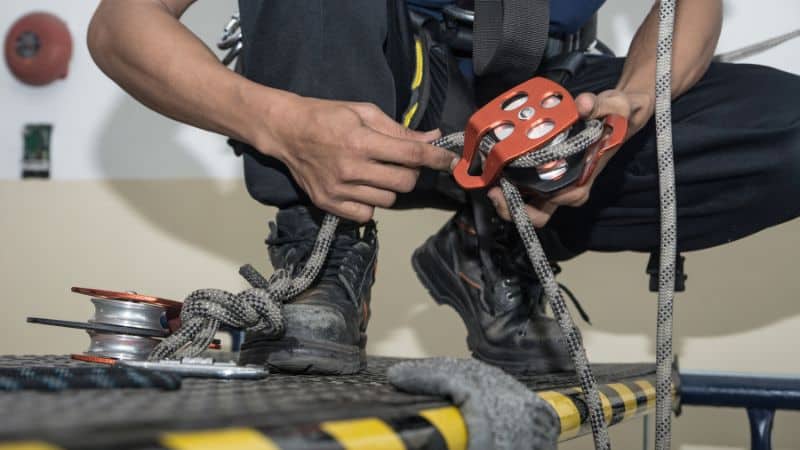
Conduct thorough safety checks before every snatch block operation. These precautions prevent accidents and equipment damage.
- Verifying the snatch block’s working load limit matches the winch’s pull force.
- Inspecting the block for damage, cracks, or wear on the sheave and casing.
- Ensuring the cable seats properly in the sheave to prevent slipping.
- Using appropriate shackles and connectors rated for the specific load.
- Maintaining clear communication and control during the entire operation.
Practical Applications and Examples
Snatch blocks serve critical functions across multiple industries, and are an indispensable choice for lifting heavy loads with great versatility. This chapter will mainly demonstrate how snatch blocks work in construction, manufacturing and mining.
Heavy Construction and Critical Lifts
In heavy construction, snatch blocks are essential for solving spatial problems and executing engineered lift plans. These heavy-duty snatch blocks can move multi-ton prefabricated components like steel trusses or industrial machinery into precise positions around obstacles where a crane does not have a direct line-of-sight pull.
A common application is a redirected lift or load line re-reeving operation where a crane must lift a heavy load when the direct path is blocked by an obstacle. Riggers will secure a high-capacity snatch block to a padeye that has been fixed into the building’s steel frame. The crane’s main hoist line is run through this block, changing the pull direction by up to 90 degrees. This allows the load to be guided on a new path clear of the obstruction, with the crane operator maintaining control via the redirected line. This technique allows a single crane to perform complex lifts from one position, saving significant time and cost compared to moving the entire crane.
However, this operation involves potential risks, so be sure to conduct an on-site assessment, consult the crane manufacturers and related experts, and comply with local regulations. (for example, OSHA, ASME B30.5 / B30.26 in the U.S.)
Industrial Rigging and Material Handling
In warehouses, factories, and mines, snatch blocks create flexible and temporary material handling systems. The unique challenge is efficiently moving raw materials through a facility.
A common example of industrial rigging and material handling utilizing a snatch block is in the field of underground mining, where heavy equipment or materials must be moved within tunnels or shafts.
In these scenarios, a winch is anchored at a fixed point outside the mine or within a stable area, and the winch line is routed through one or more snatch blocks secured to anchor points along the planned route. These snatch blocks are used to change the direction of the pull as the load travels around corners or through winding passages. This practice allows workers to efficiently and safely move heavy loads through confined spaces by making the most of available anchor points. The use of snatch blocks in such block and tackle systems is a well-established, routine procedure in mining and other industrial settings.
Conclusion
Mastering the snatch block transforms how you approach pulling and lifting tasks. It’s not just about having the right tool but understanding how to deploy it effectively and safely.
Now that you have learned how to utilize this indispensable part of the toolkits for handling heavy loads, why not find out more snatch block options at Grandlifting?
Frequently Asked Questions
How do I calculate the load on the anchor point when using a snatch block?
This is a critical safety calculation. The force on the anchor point is almost always greater than the weight of the load itself. In a simple direction change, the anchor point experiences a force equal to the tension in the rope times a factor based on the angle. For a 90-degree angle, the force is about 1.4 times the line pull. For a straight pull (180-degree angle), the force on the anchor can be nearly double the line pull. Always ensure the anchor point is rated for this higher force.
How often should a snatch block be inspected?
A snatch block must be visually inspected before every single use. A formal, documented inspection should be performed by a competent person at least annually, or more frequently as dictated by the intensity of use and company safety policy. Any block that has been subjected to a shock load or shows any signs of damage must be removed from service immediately.
Can I use a snatch block with any type of rope?
No. You must match the snatch block to the specific type and diameter of rope. Using a wire rope in a block designed for synthetic rope will damage both. Conversely, a large wire rope block will crush a smaller synthetic rope. The sheave groove must be the correct size and material for the rope to prevent damage and ensure safe operation. Always consult the manufacturer’s specifications.
What is the difference between a sheave and a snatch block?
The terms are often used interchangeably, but there is a key difference. A sheave is just the grooved wheel that a rope runs on. A snatch block is a complete assembly that includes a sheave mounted inside a frame with a side plate that opens, allowing it to be placed over a rope anywhere along its length. A standard pulley block typically requires you to thread the rope through from the end.